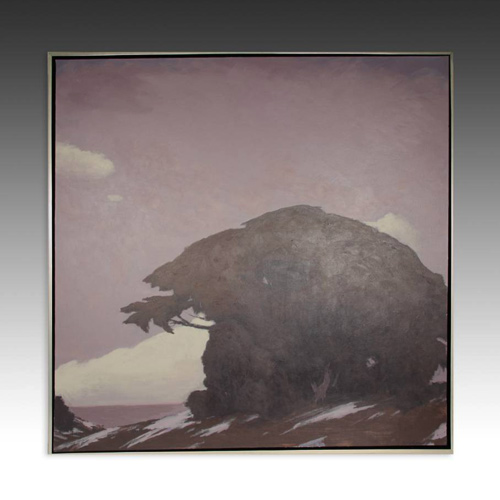
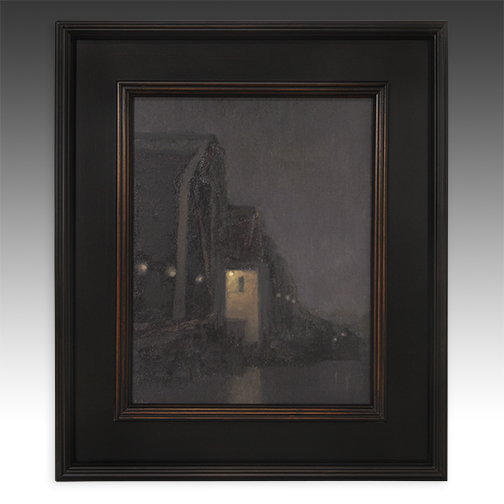
Brian Sindler is an award-winning American painter known for his unique style, which stretches the borders of traditional landscape painting. His work prompts the viewer to contemplate the mood he is conveying rather than the faithfulness of the scene he is depicting, and it evokes a familiar, calming feeling. As he concludes in the interview below, “I make paintings for people who value stillness.”
This week Primitive presents “In Search of Quiet Moments,” an exhibition and sale of Brian Sindler’s art. Prior to the opening, I sat down with Brian to talk about what led him to a career in the visual arts, how he decides what to paint, his working methods, and the painters who ultimately inspired him to paint what he feels rather than what he sees.
— Glen Joffe
The Interview
You grew up in a family steeped in art, but you were a musician before you were a painter. What led you to start painting?
My father was a jewelry designer and a Sunday artist. He would sketch designs in front of customers and add a little watercolor for effect. He could hold people’s attention with nothing more than the simple act of drawing. My sister had the gift too, but I didn’t really ask myself whether I had any aptitude for art until much later.
Years after that, I came across the work of the folk artist George Colin. His work was easy to dissect: he outlined his images and filled them in with pastel, almost like a coloring book. I thought, I can do that, and that’s how my career as a visual artist started. From there I began studying what other artists were doing, and again I thought I could do it myself. One who comes to mind is Matt Lamb, who like Colin, also had no formal training. He worked in oil and did unusual things with texture and surface. I started painting to figure out how he got his results.
Is there anything from music that shows up in your painting?
For sure, though most of it comes through subconsciously. I’ve never been very analytical about music or art. When I try to be, it usually doesn’t work.
First and foremost is improvisation. It followed me from music to painting. I use elements like trees or objects as they appear to me, and I may add or remove elements as I feel the scene, the way a musician adds or drops notes at will. I’m always willing to abandon my first idea if chance or imagination gives me something more interesting.
Counterpoint is on my mind too. I use parts of the landscape as opposing features: the terrain might slope one way and other elements another way. That’s intentional. It’s like a bass line and a melody moving in different directions.
I’m also very conscious of negative space. Where you place an object against its background determines how it’s perceived and how much interest it holds, so I place things to accentuate the space around a painting’s focal points. In music, it’s called a rest.
Finally, tone is critical to me, because it sets the mood. In music, I’d compare it to the lower register. In painting, it runs to darker, more subdued colors. I’ve found that best expresses what I feel about the landscape.
You trained formally as a figure painter, first at the American Academy of Art and then in the ways of the Old Masters at the School of Representational Art. What did the figure teach you about the outdoors?
In some ways, learning the figure as rigorously as I did was an obstacle to interpreting the landscape. In a studio, with a model or a still life, you can render exactly what you see and keep correcting for accuracy as you go. Outdoors you don’t have that freedom.
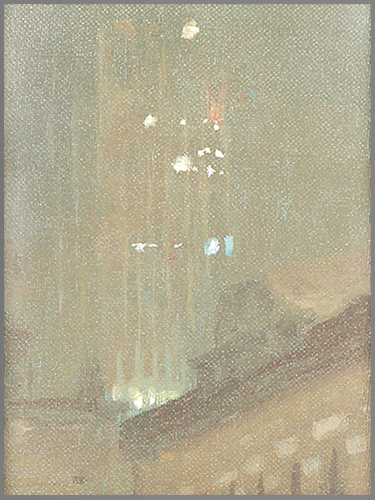
The landscape is an elusive subject, and its color values keep changing. It’s also impossible to match nature’s values exactly with paint. No pigment will exactly reproduce the sun or the sky. The colors in a landscape painting are really a reference to reality, whereas in the studio everything can be controlled with great accuracy.
How do you find your locations? What makes you stop, stare and take stock?
Anything beautiful, the same things that would probably stop anyone. The difference is that I ask myself whether it’s an image I would paint. Plenty of scenes stop me, but if one doesn’t feel like something I’d paint, however beautiful it is, I move on.
I take tons of photos with my phone. Sometimes I never go back to look at them; I just remember the elements. If time permits, I’ll sketch. I used to scout locations, but not so much anymore. Mostly I’m drawn to scenes that engage me, however I come across them. Maybe the elements look sculptural, maybe it’s simply a beautiful scene, or maybe it’s clearly a painting. In the end, I suppose the real filter is my eye.
People often tell you they feel they’ve seen your scenes before. Why is that? Are you painting a place, or what it’s like to remember a place?
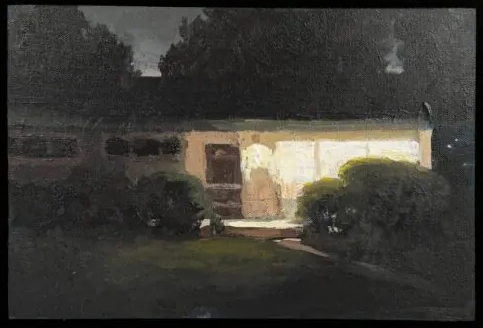
Strangely enough, it’s the lack of specificity that makes my paintings feel familiar. If I paint a sign on a building that says Wilson’s Hamburgers, the image becomes very specific. Without the sign, people are left to imagine what the building is and the mood it conveys. Landscape works the same way. Without specifics, people search their own memories for similar scenes they may have witnessed instead of seeing an exact rendering of one place. I think people ask, “Where have I seen this before?” and out of that search a sense of familiarity arises.
What decides whether a painting will be large or small? Does your method change with the scale?
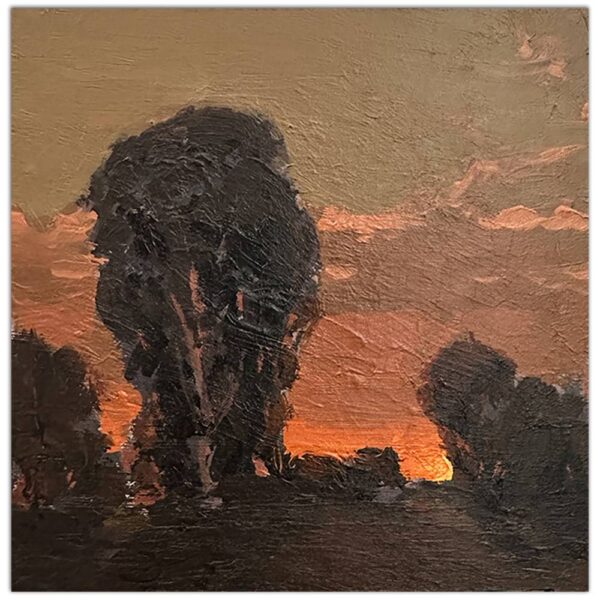
My paintings used to be scaled as large paintings presented intimate viewpoints, and small paintings presented broad vistas. Lately I’ve been experimenting with broad vistas in much larger scale. Now it’s a matter of challenging myself and deciding up front whether what I envision suits a larger or a smaller scale. There’s no natural guideline anymore.
As for method, what works small may not scale up. A single stroke on a small painting might equal a two-foot swath on a large one, so the way the canvas gets covered changes dramatically. To get the same effect, one brushstroke on a small painting might take multiple strokes, colors and shapes on a large one.
You now work mainly in acrylic and gouache. How do you choose between them?
Gouache is always reserved for small work; acrylic I use at any size. For small pieces, the choice comes down to a feeling about which will best convey the mood of the scene. With gouache I tend to paint in a more simplified way, closer to abstraction.
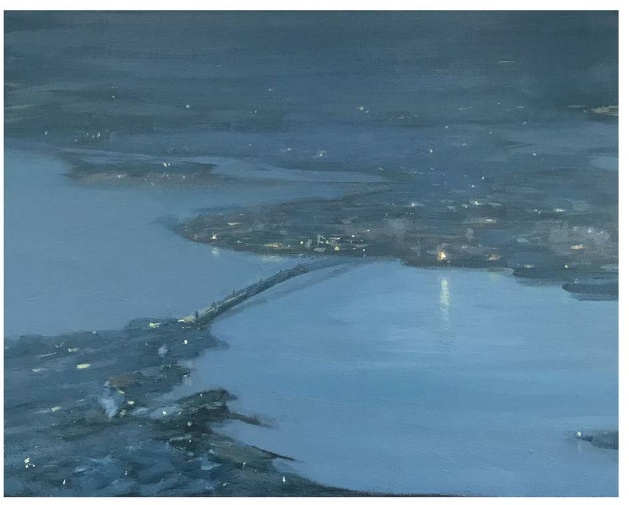
You’ve lectured about finding the right “armature,” the structure underneath a painting, and called it half the battle. How do you find it?
That question goes to design. You can think of the armature as the foundation of the painting. If the armature is weak, odds are the painting will fail. If it is strong, the painting is much likelier to succeed.
A landscape has many elements, large and small, primary and secondary shapes, and they all become part of the armature. I move them around freely instead of painting exactly what I saw. In other words, I arrange the elements as a designer would rather than faithfully rendering a scene.
So, part of my process is being a designer: laying down the elements to be painted, knowing they may shift if the design can be improved and the painting moved forward. Occasionally I’ll draw with paint on the canvas to mark the rough placement of things, but even that can change as the painting proceeds.
Which painters, living or dead, do you find most inspiring?
In roughly the order I discovered and came to admire them: Picasso, Monet and Van Gogh, Rembrandt and Whistler, Russell Chatham and Mark Rothko. All of them inspired me to focus on what I felt while painting rather than to be a faithful author of what I saw.
What do you hope someone feels when they stand in front of one of your paintings?
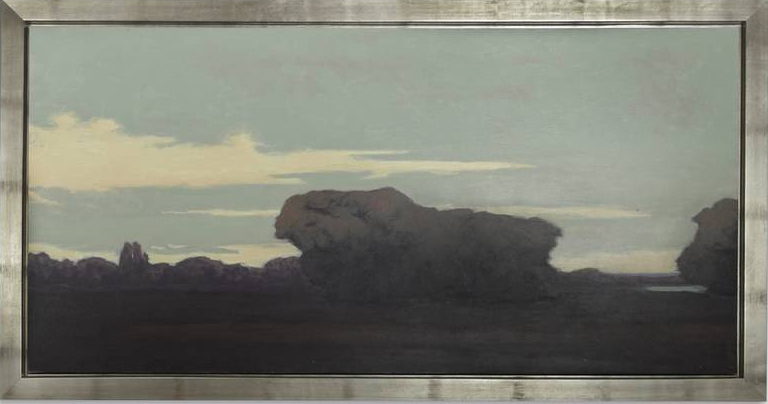
I hope they feel peaceful. We live in a world that puts such a premium on shock value, where everyone is fighting for attention. It’s reaffirming to me that people will linger with my work and find it engaging in a peaceful, meaningful way.
And if you had to describe what you do as a painter in a sentence?
I don’t set out to paint ‘calm,’ but I’m always searching for those moments when the world grows quieter than our thoughts. I make paintings for people who value stillness.