By Glen Joffe
Tom Robinson and the Minnies: Is the Need to Create Genetic?
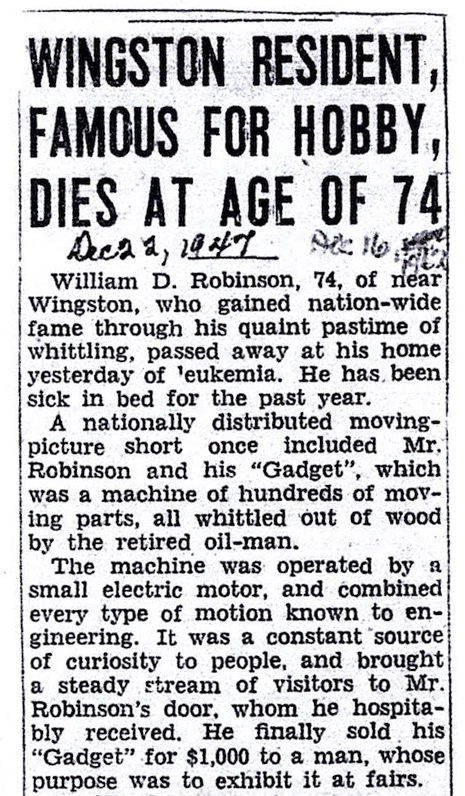
In December 1947, a newspaper in northwest Ohio ran the obituary of William D. Robinson, 74, of near Wingston. The headline did not mention that he was a farmer. Instead, it characterized him as an “oil man” because he had a single oil rig in one of his fields. Nor did it did not mention his Masonic Lodge. Instead, it focused on “his quaint pastime of whittling,” calling him famous for his hobby. Over time, his hobby had produced a machine carved from hundreds of moving parts and operated by a small electric motor. Called the “Gadget,” it had no discernable purpose except to be an endless source of amusement and curiosity. According to the paper, it combined every type of motion known to engineering. Its fame spread far and wide. Strangers knocked on his door to see it, and it was featured as the subject of a film short in theaters nationwide. Ultimately, he sold it for $1,000 to a man who took it on the carnival circuit. Robinson passed and so did the machine, but his legacy of fealty to the act of creating lived on. It was inherited by his grandson, Tom.
Although Tom Robinson was an infant when his grandfather died, he quickly picked up his grandfather’s baton. As Tom recalls, he was making things by the age of six, in part because his father was insistent that he know how to use tools. Nearly eight decades after his grandfather’s passing, he is still making things with his hands as part of a professional artistic career that has lasted for over fifty years. Tom’s devotion to creating art raises the question: is the need to create genetic? Does making art run in a family the way red hair or long fingers do?
Although an argument can be made that the drive and capacity to create art are at least partially influenced by genetics, science has not discovered a single “art gene.” Even so, Tom Robinson’s career suggests that such a gene may exist, although he supplemented whatever artistic gifts he inherited with an academic education in visual communication at Ohio State University. After graduation, he landed in the Navy, where he was utilized as an artist rather than a sailor at the Great Lakes Naval Station. Then he made the short hop to Chicago, which became his home. Over the ensuing decades he became a fixture in the Chicago art scene.
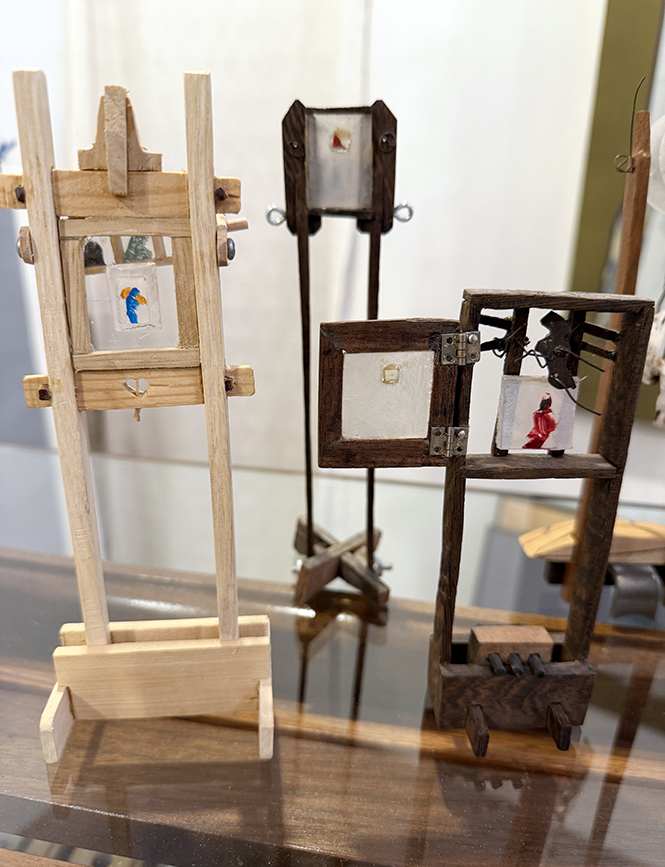
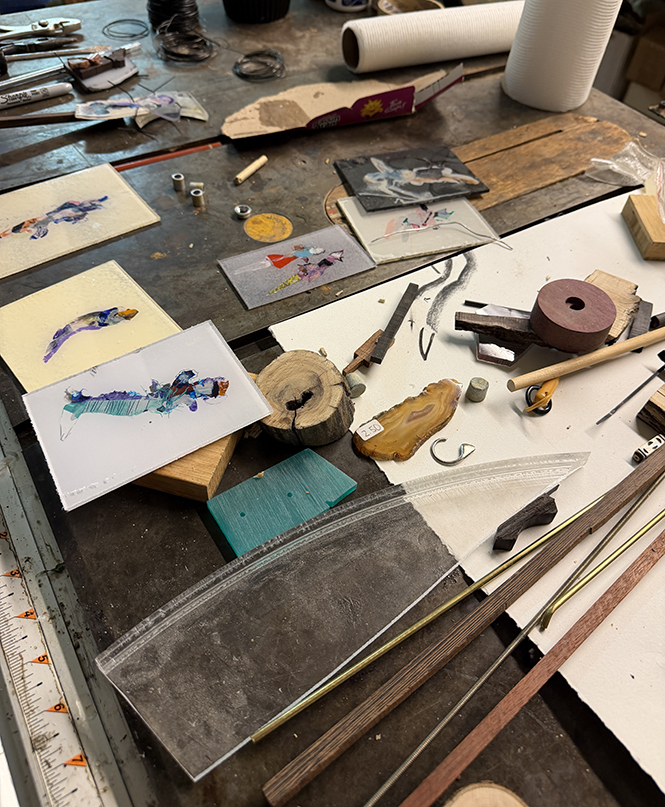
He became known for his natural wood mosaics, portraits assembled from hundreds of hand-cut pieces of wood, and for his furniture, which are as much sculpture as purely functional objects. He became the subject of magazine articles and one man shows, and early on he became influenced by the Harry Who? – a six-member collective that sparked the Chicago Imagist Movement. The imagists featured figurative, surreal, grotesque, comical, and frequently subversive images inspired by comics, ads, folk art, and everyday objects, and often championed the use of unconventional materials like plexiglass. Robinson learned the lessons of the imagists and started operating within the permission structure they had imposed on the art market. He began reverse painting on plexiglass and adopted atypical materials not commonly found in fine art like found objects, construction materials, wire and cord, and fused them into a singular style, a unique artistic language. The Minnies – the focus of Primitive’s exhibition opening November 28th – exemplify a style Robinson forged decades ago.
Minnies are easily understood as miniature sculptures, 3 to 12 inches tall. Some are meant to hang, some to stand freely on any flatsurface. Robinson uses a wide range of materials in these small, accessible gems. Paint, wood, plexiglass, wire, gauze, nuts, bolts, rods, and found materials, organic and otherwise, all find their way into small, harmonious, naturally engaging compositions. Intimate, they demand examination, even when seen from afar. The works are titled with single names like Elanor, Lattice, Baggage, Stone, Cloud, Quest, and Tryst. When viewed together they read as a population. When examined singly they read differently, each revealing a distinct personality.
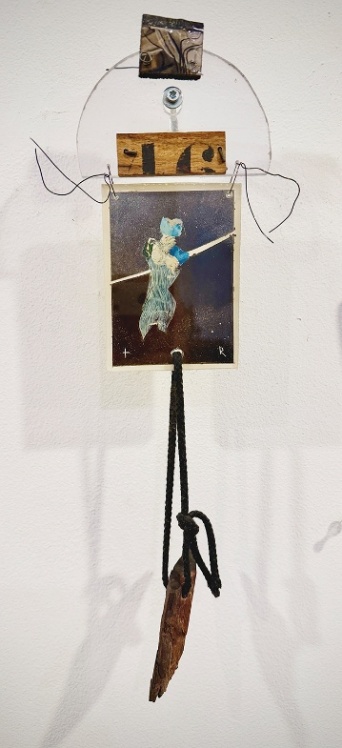
In Quest, a small figure reverse painted on plexiglass walks a white line across a night sky flecked with stars, the initials T and R scratched into the lower corners. Above it sits a scrap of old wood stenciled with numerals. Below, a knotted black cord is used to suspend a weathered stick. It reads as a drawing, cut apart and re-assembled in three dimensions, and like all Minnies begs interpretation. Each component reads as a riddle. Why is it there? What is its significance? Upon closer examination, we ask where the figure is walking? Is the suspended stick really an amulet? If it is, does it belong to the figure? Do the numerals above have any significance? Numerologically, the number 16 reduces to 7. What does that mean, and what about the fragility of the wires? All in all, we dwell, we examine, and although we may identify and even interpret one or another component, in the end we are left with the comfort of knowing this is simply a wonderful composition, easy on the eyes and clearly made from the hand and heart. The desire to interpret fades. Viewing and delight take center stage.
In Cloud, two carved, curved staves of pale wood rise from a rust-mottled block like vertical trusses. They are perfectly fitted into channels
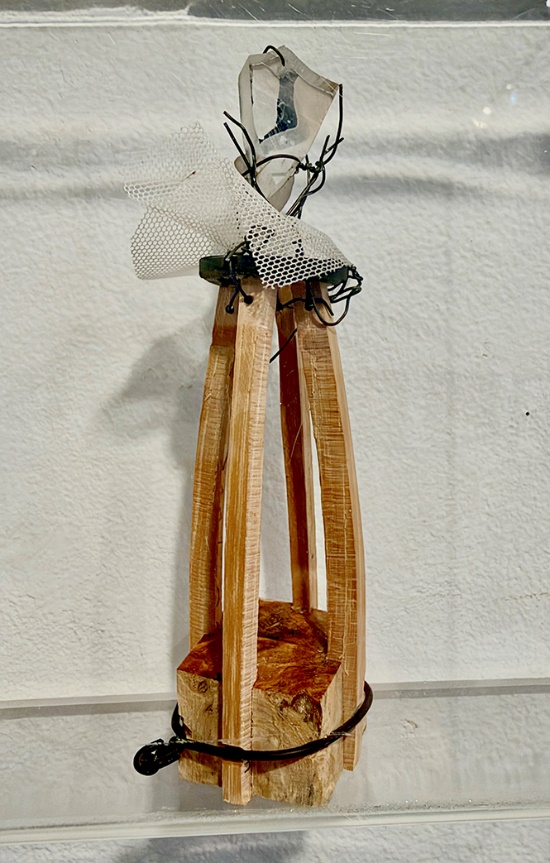
cut into the sides of the block creating individual “housed” joints skilled woodworkers call a trench, or dado. Amplified in architecture, timber framers call these let-in joints. No matter what you call them, it soon becomes clear that Cloud was thoughtfully constructed. We are left with the feeling that this piece is worthy of inspection and investigation, and as with all Minnies, an examination of one component leads to the next. Given the tightness of the joints, was the wire wrap at the bottom necessary? Or is it there to remind us that on occasion we could all use some support and assistance? At the top, a shard of reverse-painted plexiglass reading as an abstracted face rests in a tangle of wire, obscured by a partly transparent, white mesh collar flaring out like a scarf caught in the wind. Now we know where the title Cloud comes from, and if we back out for one single, grand, inspirational interpretation, the entire piece suggests there are no limits on how high we can rise. Cloud is heavy on the bottom and light on the top, and although it stands only five inches tall, has the presence of a monument.
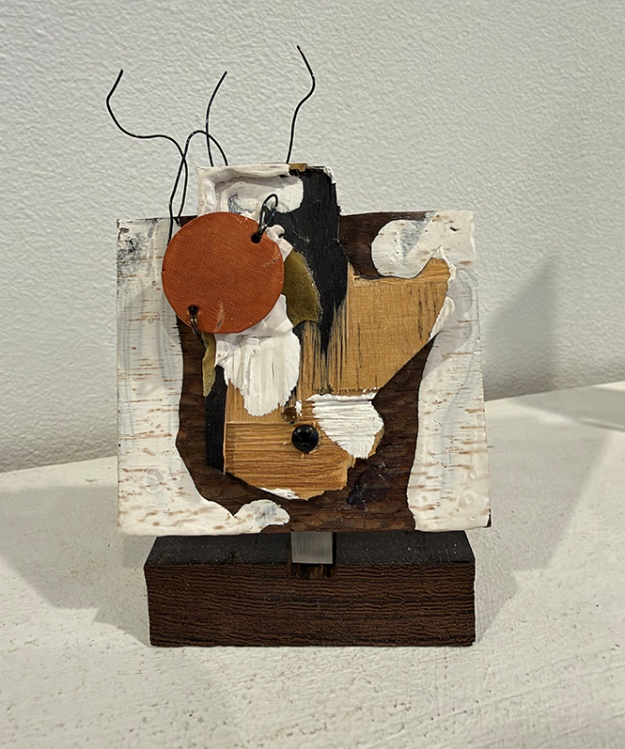
Minnies exude carefully considered construction. They are filled with mystery. Frequently they inspire self-examination. Considerthe Minnie titled, Baggage. A small square of wood is edged in a thick coat of white paint that has the flecked look of birch bark. It’s immediately recognizable as an abstract portrait mounted on a metal post above a hardwood base. The mouth is a screw. Streaked paint forms a nose. A few strands of wire hair rise from the top like trails of incense smoke. The piece becomes personal, even meditative. A blob of white paint forms its left eye. Covering the right is a terra cotta colored disc held in place by wire loops. Is it an eye patch? It could be a tag, for sitting at the top of the composition rests a handle, implying the entire piece really is Baggage. Then the title begins its work. Is this just a portrait or an invitation to introspection? If the disc is an eye patch, what is it covering? What secrets lie beneath? If it’s a luggage tag, to whom does the baggage belong? Where is it going? What is it carrying? The two readings never really settle, and perhaps that’s the point. As with all Minnies, the more we look, the more we see, and as our observation continues, we inevitably arrive at a single conclusion: at just a few inches tall, Baggage is the lightest load you’ll every carry and one of the hardest to put down.
No one has ever found a whittling gene, no less an art gene; yet Minnies make the case Tom
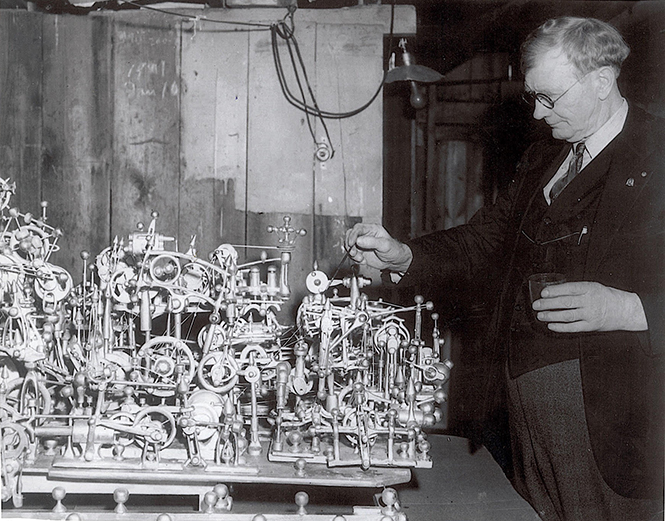
Robinson inherited something from his grandfather. Is it an urge, a calling, or could it be genetic? Perhaps it is all three, an invisible longing, even a compulsion that was nurtured and cultivated from childhood all the way through the present moment. The similarities between the Gadget and the Minnies provide evidence of the connection between Robinson and his grandfather. They testify to a creative lineage. Every Minnie is built the way the Gadget was built, from multiple small parts, each made by hand, joined together so the whole becomes a single cohesive unit. Every Minnie and the Gadget can be a source of delight, fascination, and amusement. They can excite the imagination and arouse the curious; and every Minnie and the Gadget was skillfully created with intention, which is where the similarities appear to end. The Gadget was built to move. Minnies were built to move us in small insightful ways. The Gadget was more engineering than art. Minnies are more art than know-how. The Gadget was a single work with many similar parts. Minnies comprise many individual works with a broader range of distinct parts. The Gadget was discovered nationally and ended up paraded around the country as an oddity. So far, Minnies have become popular in a local market of individual collectors and connoisseurs, but are recognized as art rather than a curiosity.
Yet, differences aside, one last similarity must be mentioned: every Minnie and the Gadget illustrate the complete devotion of the maker to creating something unique. Perhaps this is a genetic trait, activated by circumstance and opportunity. Maybe it’s just a habit fortified by repetition and reward, something that is learned rather than inherited. It might simply be that devotion is the product of desire – to be seen, to have an impact in the world, to establish a legacy. Wherever it originates, Tom Robinson has been demonstrating an unwavering devotion to creating unique art forms for over fifty years, and this is perfectly exhibited in the Minnies.
__________________________
“Minnies” can be seen and acquired at Primitive, 130 N Jefferson Street in Chicago beginning on Saturday, November 28, from noon to 5 p.m. Pieces range from 3 to 12 inches and are priced from $150 to $600.